
History · Legend · Myth
Bridge of Sighs: legend and history
A bridge built for prisoners that became a symbol of love. From the historical truth of the Prigioni Nuove (New Prisons) to Casanova's escape and the legend of the gondola kiss: here is what really lies behind the "sighs".
Disclaimer This is not the official website. bridgeofsighs.venezia.it is an independent guide, not affiliated with Palazzo Ducale or the MUVE Foundation. We do not sell tickets: bookings are made through partner platforms.Tours that bring history to life
Guided visits to Doge's Palace, the prisons and the secret corridors of Venetian power.
Most people assume the Ponte dei Sospiri (Bridge of Sighs) is a romantic monument. In fact it was built as a service passage for prisoners: the original "sighs" were not of love but of fear. Understanding this double identity — prison and myth — is precisely what makes its history so compelling.
Why it is called the "Bridge of Sighs"
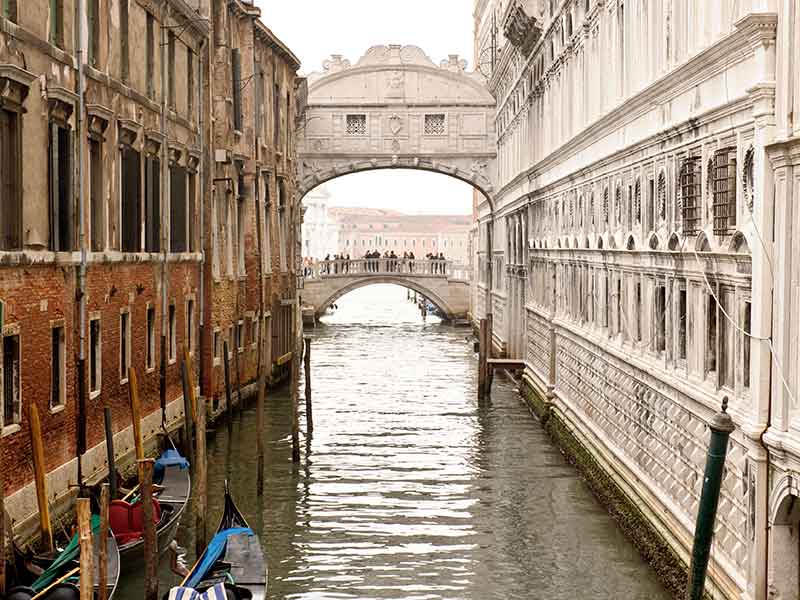
The name comes from a popular tradition: it is said that prisoners, transferred from the interrogation rooms of Palazzo Ducale to their cells, would steal one last look at Venice through the small latticed windows. That sigh — a farewell to freedom and to the city — is said to have given the bridge its name.
It is a compelling story, but it needs context. By the time the bridge was built, the Venetian Republic was already in decline and death sentences were rare. Most prisoners who crossed it were petty criminals serving short sentences. The name "Ponte dei Sospiri" is only documented from the late eighteenth century onwards: before that it was simply called the bridge of the palace, or the prison bridge.
Key facts
| Architect | Antonio Contin |
|---|---|
| Construction | 1600–1603 |
| Commissioner | Doge Marino Grimani (whose coat of arms is carved on the bridge) |
| Material | Istrian stone |
| Style | Baroque |
| Length | approx. 11 metres, double corridor |
| Connects | Palazzo Ducale ↔ Prigioni Nuove (New Prisons), across the Rio di Palazzo |
Source of historical data: Wikipedia — Ponte dei Sospiri.
The construction: a bridge to separate justice from punishment
By the late sixteenth century Venice needed new prisons. The old Pozzi cells on the ground floor of Palazzo Ducale were damp and overcrowded. The Republic therefore commissioned the Prigioni Nuove (New Prisons) on the far side of the Rio di Palazzo canal, connecting them to the palace with a covered bridge.
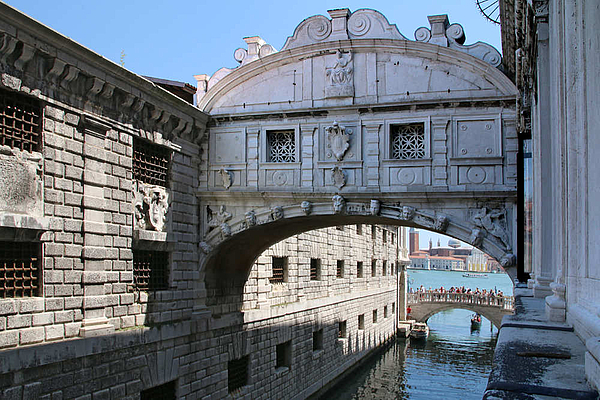
The design was entrusted to Antonio Contin, nephew of Antonio Da Ponte (the engineer behind the Rialto Bridge). Contin designed a fully enclosed bridge with two parallel corridors divided by a wall: one for the outward journey, one for the return. The windows, facing towards the lagoon, were fitted with finely worked stone grilles — large enough to admit light but not an escape.
The New Prisons and the inquisitors
At the far end of the bridge stand the Prigioni Nuove (New Prisons), one of the earliest buildings in the world designed specifically as a gaol. The stone cells were arranged across several levels around an internal courtyard.
The Venetian justice system was severe and secretive. The three State Inquisitors investigated treason and conspiracies with great discretion. Prisoners were led across the bridge to be questioned in the palace halls and then escorted back to their cells. The route visitors follow today — palace, bridge, prisons — retraces those very footsteps exactly.
"The sighs were not romantic: they were the echo of a justice that offered no way out."
Casanova: the only successful escape from the Piombi
No account of the Bridge of Sighs is complete without Giacomo Casanova. The Venetian adventurer was arrested in 1755 on charges of sorcery and impiety, and locked in the Piombi — the cells beneath the lead-covered roof of Palazzo Ducale, considered escape-proof.
On the night of 31 October to 1 November 1756, Casanova escaped by hacking through the ceiling and lowering himself across the palace rooftops with an accomplice. It was the only confirmed successful escape from the Piombi on record. He recounted the feat himself, years later, in his memoirs — pages that have fed the myth of the bridge and its prisons ever since.
Guide's note
When I take visitors on the Secret Itineraries, the most powerful moment is stepping into the Piombi cell and then crossing the bridge. Casanova escaped via the rooftops, not the bridge — but walking those narrow corridors makes it very clear why a man would risk his life to get out.
Lord Byron and the invention of the romantic name
The English name "Bridge of Sighs" we owe to Lord Byron, who opened the fourth canto of Childe Harold's Pilgrimage with the lines: "I stood in Venice, on the Bridge of Sighs; a palace and a prison on each hand." From that moment the bridge entered the European Romantic imagination.
It was an entirely literary operation: the Romantic poets transformed a prison passageway into a symbol of melancholy and fate. It is a perfect example of how a place's fame can be built more from words than from stone.
The gondola kiss legend
The modern version of the myth is the sweetest of all. It holds that if two lovers kiss aboard a gondola directly beneath the Bridge of Sighs at sunset, as the bells of San Marco ring out, their love will last for ever.
The legend is recent — it spread in the twentieth century and was picked up by cinema (it features in the 1979 film A Little Romance) — but it has become one of the reasons couples choose a gondola ride right here. Romantic or touristy as it may be, it remains a memorable experience.
Want to live the legend?
Passing under the bridge by gondola is one of the most atmospheric ways to see the monument. You'll find practical tips, times and prices in our gondola tour guide.
How to see the bridge today
History only comes alive when you actually cross the bridge. Today you can do so from the inside with a Doge's Palace ticket, retracing the prisoners' path from the halls of power to the cells. The Secret Itineraries tour adds the normally closed rooms: the secret chancellery, the torture chamber and Casanova's cell.
- Doge's Palace. Route includes the bridge and the Prigioni Nuove (New Prisons), with audio guide.
- Secret Itineraries. Guided tour of the hidden rooms and Casanova's cell.
- Free exterior view. From the Ponte della Paglia, for the classic photograph.
Walk in the prisoners' footsteps
Cross the Bridge of Sighs from the inside and discover the New Prisons on a Doge's Palace tour.
Frequently asked questions
Why is it called the Bridge of Sighs?
Because of the tradition that prisoners sighed at their last view of Venice through the bridge's windows. The name was made famous by Lord Byron in the nineteenth century.
Did Casanova pass through the Bridge of Sighs?
Casanova was imprisoned in the Piombi of Palazzo Ducale in 1755 and escaped in 1756 via the palace rooftops. The bridge belongs to the same prison complex, but his escape did not involve crossing it.
When was the bridge built?
Between 1600 and 1603, designed by Antonio Contin, in Istrian stone and baroque style.
Is the gondola kiss legend authentic?
It is a modern legend, which spread in the twentieth century. It has no historical roots, but today it is part of the bridge's romantic appeal.